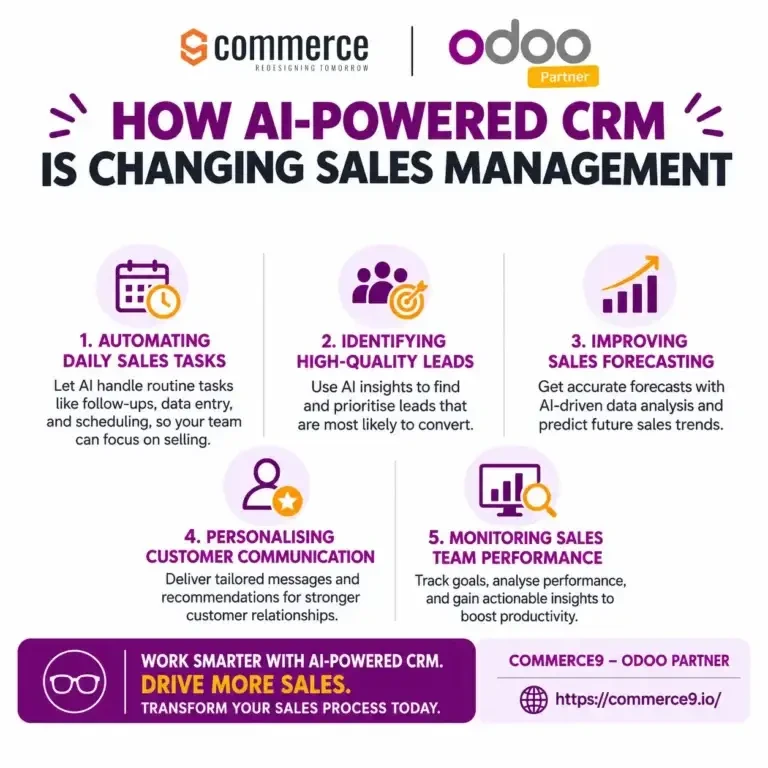
Autonomous software agents in 2026 turn customer relationship platforms into active execution systems that complete sales workflows independently instead of drafting text for human approval. Gartner projects autonomous agents will be part of 40% of enterprise applications by the end of 2026, rising from less than 5% in 2025. Better multi-step reasoning models and accessible application programming interfaces drive this expansion, helping revenue teams cut administrative workloads by up to 30%.
Enterprise CRM Transitions from Record Keeping to Direct Action
Enterprise CRM architecture in 2026 works as an active intelligence layer that executes transactions rather than a passive database waiting for manual updates. As Kate Leggett, Forrester analyst, noted regarding this transition, “CRM in 2026 is undergoing a structural shift, not just an incremental evolution.” The underlying customer database retains its role as the authoritative system of record for account histories and pipelines. AI sits directly above that repository, generating predictive signals and taking actions across external channels without replacing core data tables.
Adoption metrics confirm this structural repositioning across enterprise software. Gartner projects that autonomous AI agents will be incorporated into 40% of enterprise applications by the end of 2026, expanding from less than 5% in 2025. Research from SellersCommerce indicates that 81% of organizations use AI-powered CRM systems. Neil Ward-Dutton, IDC analyst, observed that “Organizations that rethink CRM as a real-time, AI-powered system of action — and embrace agentic AI to handle complex, unpredictable work — are better positioned to deliver exceptional customer experiences.”
Revenue leaders evaluate these deployments against concrete operating outcomes rather than interface novelty. Production environments show measurable financial returns, with deployments generating a 21% to 30% increase in sales revenue alongside a 30% reduction in administrative overhead. McKinsey research similarly links AI implementation in customer management to lead increases of more than 50% and operational cost reductions reaching 60%. Because platforms now parse unstructured communications and trigger account actions directly, sales teams spend less time logging data and more time closing qualified opportunities.
Delegating Operational Tasks from Copilots to Autonomous Agents
The operational shift from reactive copilots to autonomous execution agents centers on granting independent decision rights within defined workflow boundaries. While assistive copilots require human reps to inspect research, edit drafts, and approve record updates, autonomous agents evaluate criteria and carry out tasks without requesting permission at each step. This delegation relies on improved multi-step reasoning models and accessible application programming interfaces, which allow software to parse inbound messages, reschedule calendar invites, and update pipeline stages on its own.
Revenue operations teams manage this delegation by establishing strict boundaries between assisted tasks and autonomous execution. Rather than handing over full pipeline control, operational leaders deploy a structured decision framework to govern four critical handoff points:
- Account selection: Copilot mode requires human reps to manually review prospect lists and select targets. Autonomous execution agents evaluate inbound intent signals, match records against defined ICP parameters, and assign accounts automatically without human filtering.
- Message execution: Copilots generate draft messages that sit in an inbox queue until a rep reviews and sends them. Autonomous agents generate contextual messaging, send outreach directly across approved channels, and adapt campaign cadence based on prospect engagement.
- Bidirectional field writeback: To prevent duplicate record creation or accidental data overwrites, operations teams establish strict field ownership rules. High-confidence operational fields use explicit sync rules, while conflicting updates route to human owners for verification.
- Automated stop conditions: Autonomous agents monitor inbound responses against hard-coded stop triggers. System triggers halt outreach sequences immediately upon receiving unsubscribe requests, email bounces, out-of-office replies, or referrals to alternate stakeholders.
Moving from manual execution to supervisory exception handling protects pipeline data integrity. Unchecked writeback permissions create duplicate contacts and overwrite account histories when duplicate prevention logic is untested. By testing record matching rules across both unassigned and existing accounts, revenue teams expand autonomous execution safely while reserving human intervention for ambiguous responses and high-risk exceptions.
Coordinating Revenue Strategy Across Interconnected Agent Networks
Strategic revenue engines coordinate go-to-market execution by linking specialized agents into shared multi-agent networks across revenue operations. Single agents manage task execution inside functional silos, but interconnected systems pass context across marketing, sales development, and account management without manual human handoffs. Burley Kawasaki, Global VP of Product Marketing and Strategy at Creatio, outlined the importance of this architecture: “Agentic automation is not simply another technology trend. It is the foundation of how enterprises will innovate, compete, and grow in the AI Economy.”
Executive priorities reflect this shift from isolated task automation toward cross-functional alignment. Creatio research indicates that 86% of C-level decision-makers view AI agents as important to their strategic goals over the next two to three years. Instead of requiring employees to move data between disconnected applications, autonomous networks trigger actions across systems through standardized application programming interfaces. Marketing agents qualify lead behavior and hand account context directly to outbound sales agents, which initiate targeted outreach and notify account executives when prospect engagement hits defined thresholds.
Sustaining this strategic orchestration requires unified real-time customer data across customer relationship management and customer data platform environments. Multi-agent workflows stall when operational records remain fragmented in departmental data silos. When underlying data remains clean and accessible, autonomous networks align daily execution with macro revenue planning, rebalancing sales territories and pipeline capacity dynamically as market conditions shift.